
Unplugging to Recharge and Regroup
More sanctioning of dissent—including here in Nova Scotia—and a note to readers

Lately I’ve been feeling off kilter, and I have a good sense as to why. With the advent of social media combined with the smart phone, the speed at which disturbing news is coming at me—at us—is not easily processed by our nervous systems.
Viewing violent images, unintentionally as I scroll, just isn’t something my system is capable of integrating or making sense of. Plus, some of it now—how much is anyone’s guess—is being AI-generated and is not real. By design or by chance, this is sowing even more doubt and division in our society.
Who among us can tell for sure what is true anymore?
What I do know is that I’ve been simultaneously sad and angry. Sure, I can channel some of this emotion into physical activities, throwing some clay, and into writing even, but none seems to completely quell the discombobulation. At the same time, I’m well aware that a fearful mental state and polarized society are needed by the surveillance capitalists to achieve their dystopian vision, a subject that I’ve explored in the past.
I’m resisting this when and where I can. For instance, currently I’m taking a 60-day detox from social media – no Facebook or Twitter/ X. Two weeks in, I’ve noticed a couple things: I have a lot more time because it was becoming habitual for me to go to these platforms and spend 15 or 20 minutes at a time there—particularly when bored— as opposed to being intentional and disciplined about it. I have known for a long time that much of what’s in my feed isn’t by my choosing, and quite frankly I’m done with being manipulated by algorithms, which are designed to maximize profit and erode attention spans.
Second, some spaciousness has returned and my mind is less cluttered with disturbing, and confusing content.
Patterns are becoming clearer, but so is the trajectory, unless a good number of us start to resist.
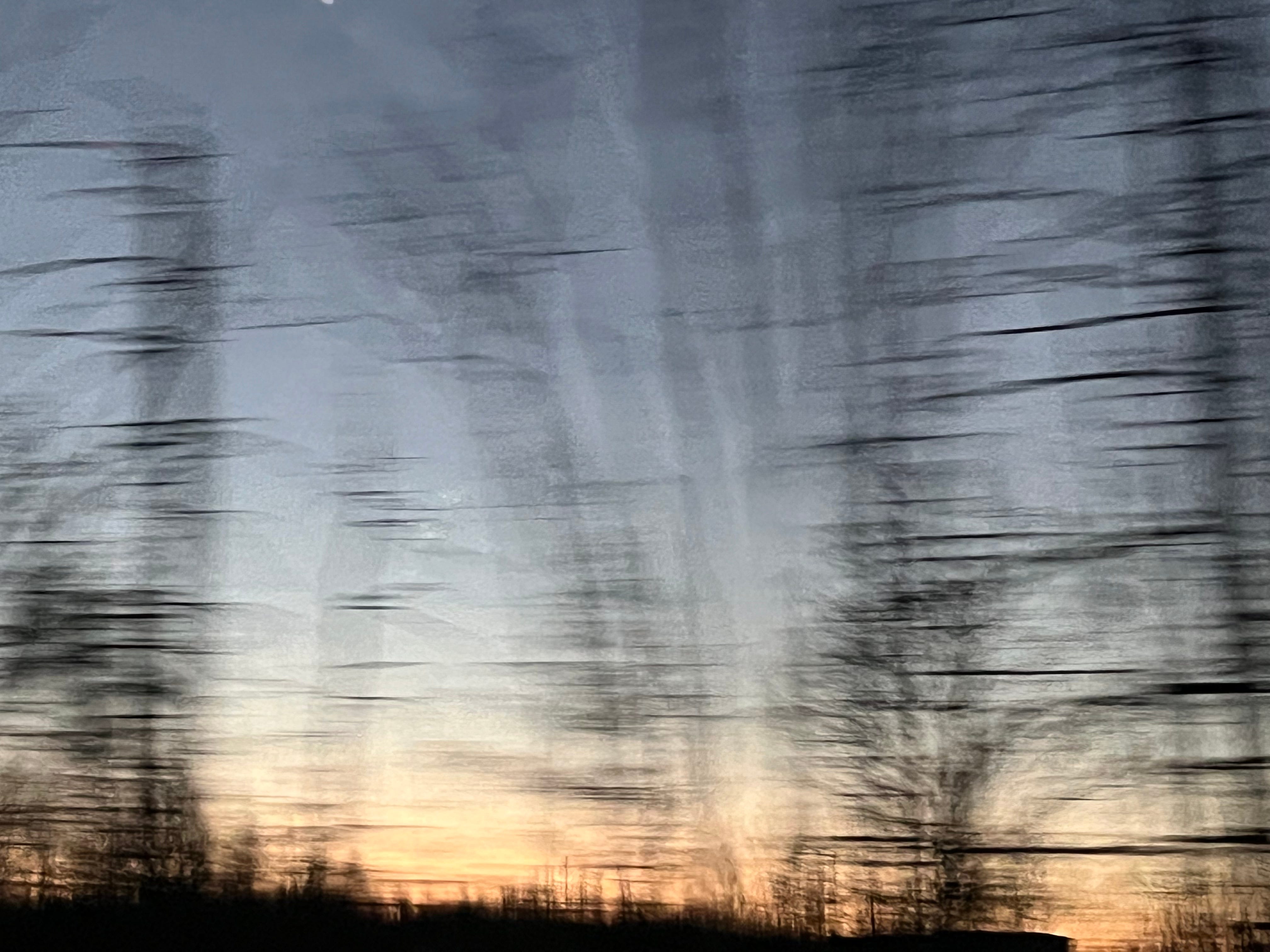
Burned forest at sunset from a moving vehicle. Photo: Linda Pannozzo
Don’t say I didn’t warn you
In 2024 I published a three-part series, titled “Sanctioning Dissent,” and noted how use of the terms “enemy of the state,” “national security threat,” “terrorist,” or even MDM—misinformation, disinformation, and malinformation—can be used by governments to censor expression and criminalize political activism. These labels can also be used to justify the unleashing of “financial tools” – such as freezing bank accounts – to stop a protest that disrupts the economy, for instance, or poses a threat to the public’s adherence to an official narrative. All of these ways of sanctioning dissent represent a dangerous detour away from a participatory democracy.
From Part 3 in the series “Sanctioning Dissent”:
Laws that are being drawn up to criminalize and surveil “anti-government sentiment” won’t care what side you’re on. These laws, coupled with the enhanced ministerial authorities and the policy-driven definitions can be weaponized against anyone who dares to challenge the government in power.
Let’s face it, anyone can be labelled a security threat: someone not wearing a mask, someone who’s not vaccinated, someone blocking a pipeline, someone blocking a logging road or a major trade route, or demanding a cease fire, or setting up an encampment on a university campus calling for divestment… all of these can be (and have been) labelled dangerous or a threat to security, depending on who’s doing the labelling.
I also want to revisit something else I pointed to in that series, which was that there seems to be a mismatch between reality and what’s being portrayed by the government as an increasing domestic threat level. I cite a few examples in that piece—including how the Trudeau government characterized crowd-funding platforms as a “tool” for money-laundering and terrorism financing, to justify regulating them, while this was not supported by facts.
Similarly, the government characterized the Ottawa protests—a subject I covered extensively at the time—as posing a national security threat, thereby justifying the use of the Emergencies Act. However, as we discovered during the Public Order Emergency Commission hearings, there was no evidence “in the intelligence” of espionage, sabotage, or foreign influenced activity that involved the threat to any person relating to the Ottawa blockade. You can read my post about this here.
As reported previously, the Canadian Civil Liberties Association took the federal government to court over the legality of the invocation of the Act, calling it “unreasonable” and not rooted in fact, and in January 2024 the Federal Court agreed that the required threshold was not met. This decision was appealed by the feds, and remains in the court system at this time.
Of course these tactics aren’t new. We recently learned that Canada’s intelligence agency planted false information during the Ipperwash protests between 1993 and 1995 when the Chippewas of Kettle and Stony Point First Nation were protesting over long-held legitimate grievances. That protracted protest culminated in the death of Anthony “Dudley” George, who was shot and killed by Ontario Provincial Police (OPP) in 1995 at Ipperwash Provincial Park.
According to recent reporting from the CBC, the OPP at the time received intelligence from an investigator from Canada’s Security Intelligence Service that the Indigenous protestors were in possession of weapons, information that likely played a role in the tragic events of 1995. But newly declassified internal documents obtained by CBC “confirm CSIS was conducting a secret and previously undisclosed countrywide investigation into ‘Native extremism,’… [and] Canada’s spies may have been circulating false information by claiming the activists were armed when they actually had no guns, as multiple investigations later found.”
Indigenous protest was being labeled “native extremism” and “terrorism.”
My two-part series titled “Ipperwash and the Freedom Convoy,” published in 2023, explored the role and independence of police in responding to protest, as well as how well the media served the public in its reporting, particularly when these situations were deteriorating.
Despite these glaring examples of protest being shut down as a result of it being mis- characterized as extremist or dangerous, the Canadian government has just proposed a new law—Bill C-9, the Combatting Hate Act—that regardless of the outcome of the CCLA’s current case in appeal court re: the invocation of the Emergencies Act, could make the denial of fundamental freedoms, like peaceful protest, much easier in Canada.
Meanwhile, south of the border, the US government under President Trump has designated antifa—short for anti-fascist—a terrorist group. But according to journalist Chris Hedges, the group has “no formal organization or structure” and labelling it a terrorist organization “permits the state to charge us all as terrorists.”
“The point is not to go after members of antifa,” writes Hedges, “it is to go after the last vestiges of dissent.” Lest we all think the problems all started with Trump, Hedges reminds us that during the Occupy Wall Street encampments, it was President Barack Obama who oversaw the “coordinated national campaign to shut down” the encampments, and antifa was “the excuse.”
Similarly, across the Atlantic in the UK, it has recently been reported that the government’s inclusion of the protest group Palestine Action in its terrorist listing has resulted in the arrest of more than 1,600 people, of which 138 have been charged for allegedly expressing support for the organization.
It should be clear as day at this point how these, and other similar government actions in numerous western so-called democracies, can and likely will have a chilling effect on free speech, censor strong opposition to political authorities, and limit debate and dissent on contentious issues, particularly when it contradicts the official narrative.
Peaceful assembly, which includes protest that is disruptive, is being treated as a crime, and democracy is being undermined and eroded through a raft of new or “modernized/ updated” laws and terror listings, each one incrementally eroding our fundamental rights and freedoms—despite them being guaranteed under the Charter. These changes are being justified in the name of safety: the need to keep us safe from viruses, safe from hate speech, safe from terrorism, safe from bad information.
But do they?
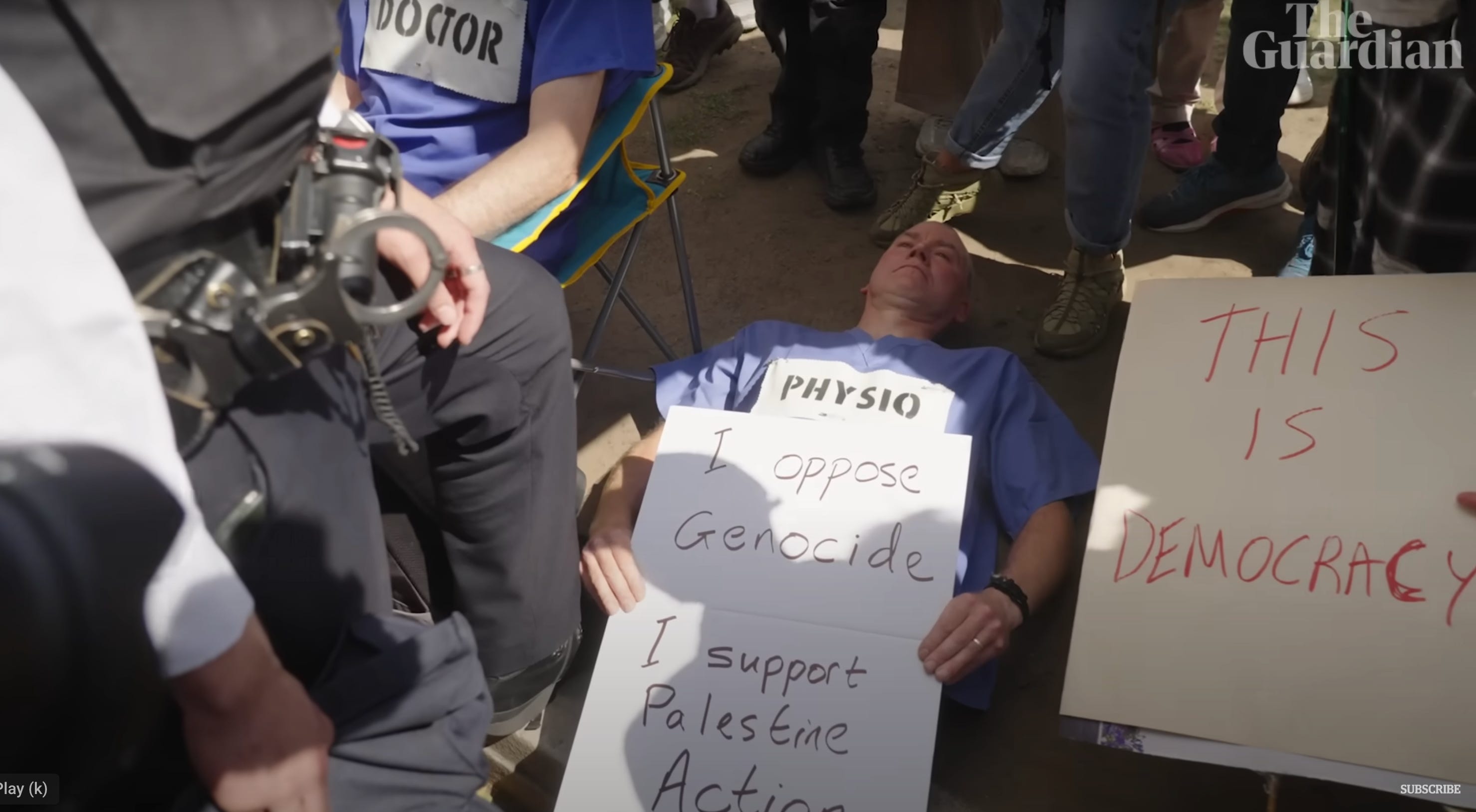
Screen grab from video of UK protest that resulted in hundreds of arrests for allegedly supporting Palestine Action, a group that was proscribed as a terrorist organization by the UK government. Source: The Guardian
Meanwhile, here in Nova Scotia
Here in Nova Scotia, BlackRock boy Premier Tim Houston continues to transform the province in ways that favour large industrial interests at the expense of the natural world. A recent government release announced a number of new laws embedded in an omnibus bill, including the Making Business Easier Act, which the government says will reduce red tape, the regulatory burden, and “position the province to compete globally in sectors such as critical minerals and clean energy,” “making it easier and faster to move mining projects forward.” This needs to be considered along side other neoliberal moves made by this government including the scrapping of the unanimously passed Coastal Protection Act, and the secretive changes made to the interpretation of what qualifies as a wetland of special significance, potentially delisting thousands of hectares of this endangered ecosystem in the province, all in the name of facilitating development.
Just seven months ago, Houston’s government tabled another omnibus bill that would repeal the existing Uranium Exploration and Mining Prohibition Act, lifting the ban on uranium exploration. He did the same about hydraulic fracking, which had been banned since 2014 in the province, except for research purposes.
In this week’s omnibus bill—and now on my radar—the Houston government also introduced amendments to the Crown Lands Act making it illegal to block, obstruct, or impede access roads on Crown land and to grant officials authority to remove hazardous structures without notice, and allowing for fines from $2,000 to $50,000 for failing to comply. According to reporting from APTN News, the province argues these blockades harm the province’s economic interests, and put public health and safety at risk. The amendments come while an Indigenous blockade of logging in the Cape Breton Highlands continues.*
Over the last several years, the Mi’kmaq Land Protectors have engaged in protecting lands with spiritual and cultural significance often through direct action. As well, there’s been an informal group of “citizen scientists” as well as Save Our Old Forests who have also been successful in raising awareness, and pausing some logging operations by setting up camp and identifying species at risk, biodiversity value, as well as old growth. Will these tactics now be criminalized by this amendment to the Crown Lands Act?
If the timing of this amendment prohibiting the blocking of logging roads on public land isn’t suspect enough— add in the recent decision on the part of the Department of Natural Resources (DNR) to open up a proposed wilderness area about 30 minutes from Halifax to clearcut logging. Roughly 196 hectares (483 acres) within the St. Margaret’s Bay watershed — with 77.5 ha (191.5 acres) of clearcuts within the proposed Ingram River Wilderness Area (IRWA)—is slated for perpetual clearcutting of the “high production” kind. Read liquidation.
A few weeks ago I submitted a FOI request for the unpublished “biodiversity assessment” on the Ingram River area. It was conducted jointly by the Department of Environment and Climate Change and Department of Natural Resources (then Lands and Forestry), with the help of the St. Margarets Bay Stewardship Association and the logging company, Westfor.
As I was drafting this post, I received an email notifying me that the package was ready. As readers may have already seen, I posted a very brief (for now) summary about the FOI findings, including the pdf of the package itself. There will be more to come on this in the coming weeks.
If you’re interested in reading a bit more about the proposed Ingram River wilderness area , please check out some of my earlier writing in this two-part series, “Backroad Deal.”
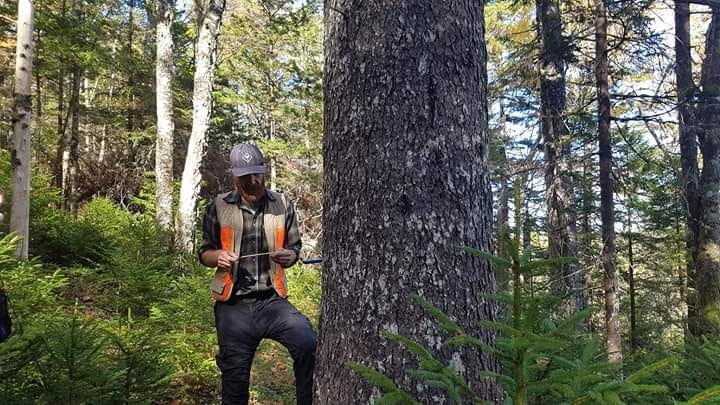
Mike Lancaster, Stewardship Coordinator of the St. Margaret’s Bay Stewardship Association (SMBSA) holds his increment board, an instrument to take a core sample to measure the tree’s age, his increment board was too small. Lancaster estimated this red spruce within the proposed Ingram River Wilderness Area to be between 250-350 years old. Courtesy: Mike Lancaster; Credit: Nick Horne.
Taking a one-month hiatus
I also wanted to let you know that I will be taking time off in October this year. I’m going on a long-anticipated walking trip in Spain with a good friend, leaving tomorrow, and as such have decided to put the Quaking Swamp Journal on pause for a month.
Rest assured, this means that all paid subscribers will have their billing cycle frozen: monthly subscribers won’t be charged until the newsletter resumes and all annual subscribers will have their subscriptions extended by a month.
There have been a number of new and returning paid subscribers recently (thank you!) and this pause will give you some time to peruse the archive — there are more than 100 articles posted to date.
The pause will not affect unpaid subscribers — so please continue to share the posts and encourage folks to sign up. While these new readers will not be able to purchase a subscription during this time, like everyone, they can still subscribe and will continue to be able to access the complete archive of articles, and will still be able to share them.
The good news is I have a backlog of research and story ideas that I look forward to sharing with you, including some reflections about my walk. I’ll be posting a photo essay on this Substack about it at some point when I’m back.
Until then, thank you again for supporting my work and for your patience. I hope to return refreshed and ready.
*The blockade in Cape Breton is currently ongoing. The original post said the legislative changes came “on the heels” of the blockade. A story just now on the CBC reports that Mi’kmaq chiefs say legislative changes “are raising tensions” at the protest site.
Your article rings so true! Thank you and have a wonderful walk in Spain. Are you walking part of the Camino?
Thanks for all you do, Linda. I wish you an enjoyable, rejuvenating trip and look forward to what you will have for us in the future. Sending love.